 Back to News & Insights
Pride and Policy: Problems Worth Fixing and Progress Worth Celebrating
June 30, 2026 • Reading time 7 minutes
Pride is a celebration, but also an annual reminder of the barriers still faced by LGBTQ+ people, who year after year are shown to have poorer physical and mental health outcomes than the general population (Khanolkar, 2024).
The numbers tell the story. In the government’s National LGBT Survey (2018) of over 108,000 people, at least 16% of respondents who accessed health services reported a negative experience due to their sexual orientation. Mental health support was a particular sticking point: among survey respondents who accessed mental health support, over half said they felt they had waited too long. Additionally, the data suggests trans people remain particularly marginalised in healthcare contexts: trans respondents of the survey were among the most likely to report a negative experience after coming out to a practitioner.
Behind these figures is a recurring pattern: services aren’t always designed with LGBTQ+ people in mind, long waits and experiences of discrimination can all lead people to delay or avoid care.
Last Pride, we looked at one root cause of these inequalities, the LGBTQ+ data gap. This data gap only further reinforces and hides the challenges facing LGBTQ+ people. This year, we look at the health services that do exist to support LGBTQ+ people and the remaining challenges the LGBTQ+ population accessing healthcare still face.
Initiatives to Help Tackle Health Challenges Faced by LGBTQ+ People
We have compiled a list of initiatives that aim to tackle health challenges faced by LGBTQ+ people. These are at least partially funded by the NHS and free to access. If you are in need of urgent mental or physical health care, always call 111/999.
Sexual Health
One of Europe’s largest sexual health and HIV clinics. Home to TransPlus (NHS England’s first integrated gender, sexual health and HIV service) and 56T (a trans-led service covering screening through hormone monitoring).
Mental Health
Run by and for LGBTQ+ people, offers online support, peer mentoring and counselling nationwide; Switchboard’s national helpline is open to anyone, anywhere to answer any questions about sexuality, gender or relationships.
Shaped for and by trans and non-binary people, Waiting Well is a pilot programme currently open to adults who live in South West England, with ambition to roll out nationally. It is designed to support people waiting for gender identity healthcare under the NHS, who may experience a decrease in physical as well as mental health. They host a support line, workshops as well as peer support groups to help reduce uncertainty people face while they wait for gender-affirming care.
Specialist Services
UK Cancer and Transition Service (UCATS)
A world-first national clinic uniting cancer and gender specialists for transgender and gender-diverse people facing cancer, which may be particularly difficult for several reasons, such as interaction between gender-affirming hormones and cancer treatments.
Further Information
There are lots of other initiatives that support LGBTQ+ people with physical and mental health. For further information on these services designed for LGBTQ+ people, see links below.
https://www.akt.org.uk/resources/inclusive-lgbtq-sexual-health-services/
https://www.akt.org.uk/resources/mental-health-resources-for-the-lgbtq-community/
Barriers to Care
These initiatives sit alongside NHS provision, including gender dysphoria clinics. Their existence does not mean the barriers have gone away. For many LGBTQ+ people, accessing care still means the risk of discrimination, lack of access to services including gender dysphoria clinics and navigating the long waits, the very pressures these initiatives are trying to relieve. We want to highlight some of these barriers below.
Lack of awareness in non-specialist services
It is positive to see that some NHS systems are funding initiatives such as MindOut that advocate for LGBTQ+ people and their health. However, for LGBTQ+ people who use health services such as their GP or local hospitals, their experiences vary. The National LGBT Survey identified a common issue: an assumption by staff that patients are heterosexual and cisgender. Trans respondents are more likely to report a negative experience after disclosing their identity, a phenomenon known as ‘trans broken arm syndrome’. Awareness initiatives such as the NHS Rainbow Badge aim to address this, though there is ongoing debate about how far such schemes go without consistent funding and training.
Provision of care specifically designed for LGBTQ+ population is unevenly distributed
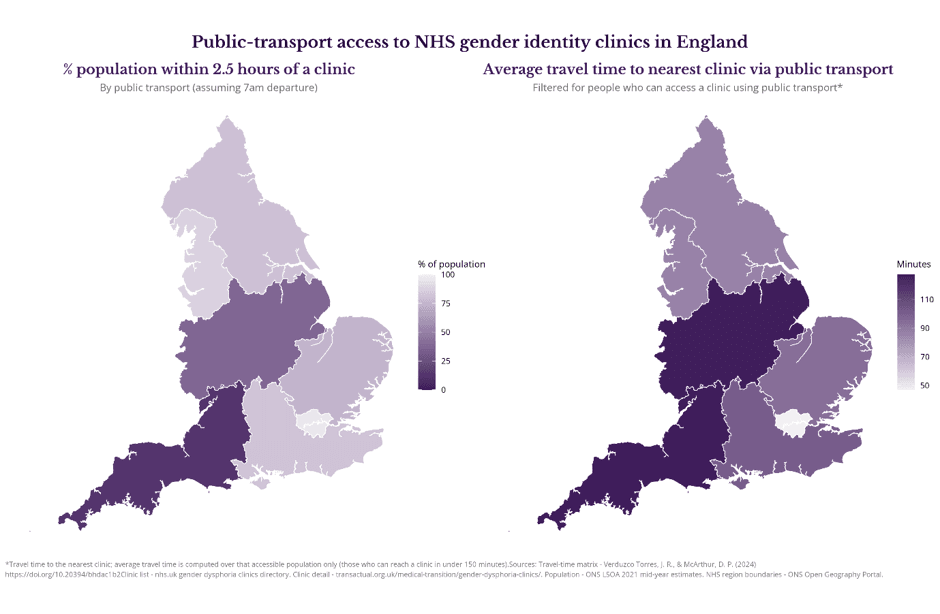
While some of the initiatives we outlined in the previous section, such as UCATS and MindOut, are national, most services are concentrated in small areas such as London and Manchester. The lack of geographical spread exacerbates the problem LGBTQ+ population living in more rural areas face. For example, for trans and non-binary people, the provision of NHS gender services is uneven throughout the country. The Levy Review of adult gender services (NHS England, 2025) found that while every NHS region has at least one adult gender clinic, there are significant gaps in the West Midlands and around Bristol. Children and young people face an even thinner spread. NHS provision is limited to a handful of regional services with waits of around three years, though NHS England has committed to a service in every region.
For people outside the main urban centres, access can mean a long journey or reliance on an online service. For a map of accessibility, see graph below.
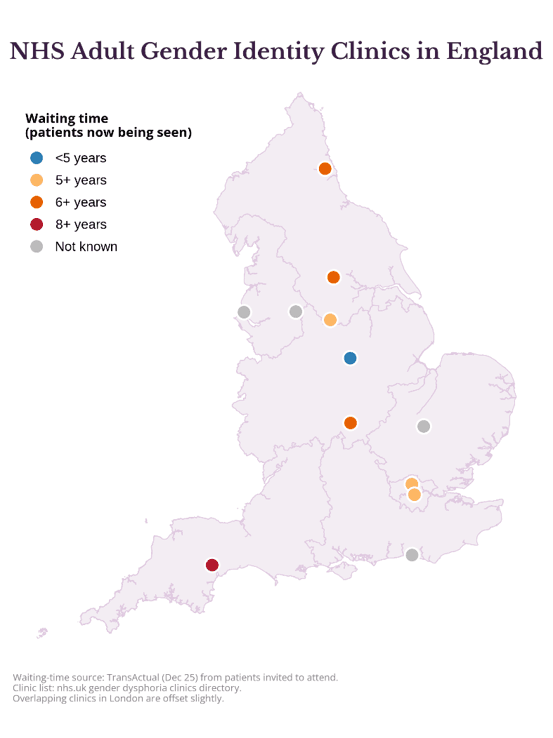
Long waiting list experienced by trans and non-binary people accessing gender clinic
Initiatives such as Waiting Well support trans and non-binary people, aiming to improve their lives as they wait for medical transition. However, they do not solve the underlying challenge faced by trans and non-binary people – more than 40,000 individuals are on waiting lists for an NHS gender dysphoria clinic, with average waits of around five years. The long and sometimes unclear waits are detrimental – 71% of trans and non-binary people on the waiting list for gender dysphoria clinics report their health worsening while they wait.
Crucially, the waiting time data is not published by NHSE. This leaves a blind spot, as the long waits experienced by trans and non-binary people for gender affirming care are left unscrutinised within the NHS and outside.
People can lose the services they rely on
Several of the initiatives described above, including Waiting Well and some of the newer gender services, exist as pilots. A pilot is a new programme tested on a smaller scale before any decision is made about whether to fund it permanently, which means that for the people relying on it, continuation may not be guaranteed. Waiting Well, for example, currently supports only adults in the South West, with the hope of a national rollout that has not yet been confirmed.
Part of what makes it hard for these services to move from pilot to permanent is a lack of data evidence demonstrating their impact, which comes back to what we wrote about last year – the LGBTQ+ data gap. When sexual orientation and gender identity are not consistently recorded, it is difficult to show who a service is reaching and what difference it makes, and therefore why it deserves long-term funding. So services set up to relieve the very barriers described above may find it hard to secure funding. This is where robust evaluation matters.
Conclusion
Individual services, however effective, can only ever address parts of the problem. The initiatives highlighted in this post are positive examples with many designed and delivered by the communities they serve, but they operate alongside gaps in geography, waiting times and everyday care that they were not set up to close on their own. Addressing those gaps is generally seen as requiring a more holistic approach: clearer national expectations for inclusive care across all services, more transparent data on gender dysphoria clinics waiting times, better data on sexual orientation and gender identity so inequalities can be measured, and routes for successful pilots to become permanent.
Zooming out to a national level, there are some additional developments to watch in the space of healthcare for the LGBTQ+ population. In April 2025, the government commissioned NHS England’s first LGBT+ health evidence review, led by Dr Michael Brady, due to conclude in January 2026 with a final report and recommendations for the Secretary of State for Health and Social Care. Its findings could inform a more coordinated strategy, which we hope will be followed by clear actions that fund gender-affirming care and support initiatives working alongside.
References
Department of Health and Social Care. (2025). Fit for the future: 10 Year Health Plan for England. GOV.UK. https://www.gov.uk/government/publications/10-year-health-plan-for-england-fit-for-the-future/fit-for-the-future-10-year-health-plan-for-england-accessible-version
Government Equalities Office. (2018). National LGBT survey: Summary report. GOV.UK. https://www.gov.uk/government/publications/national-lgbt-survey-summary-report
Khanolkar, A. R. (2024). Sexual minority health inequalities — why are we unable to do more? BMC Global and Public Health, 2, Article 66. https://doi.org/10.1186/s44263-024-00066-1
The King’s Fund. (n.d.). Tackling LGBT health inequalities — or just talking? https://www.kingsfund.org.uk/insight-and-analysis/blogs/tackling-lgbt-health-inequalities-or-just-talking
LGBT Foundation. (2026). South west pilot support service launches to improve how trans people experience NHS waiting lists, with plans to go national. https://lgbt.foundation/south-west-pilot-waitingwell/
NHS England. (n.d.). Operational and delivery review of NHS adult gender dysphoria clinics in England. https://www.england.nhs.uk/long-read/operational-and-delivery-review-of-nhs-adult-gender-dysphoria-clinics-in-england/
TransActual. (n.d.). Gender dysphoria clinics. https://transactual.org.uk/medical-transition/gender-dysphoria-clinics/
Verduzco Torres, J. R., & McArthur, D. P. (2024). Public transport travel time matrices for Great Britain (TTM 2023) (Version 2023.1) [Data set]. Zenodo. https://doi.org/10.20394/bhdac1b2

Daniel Eaton
Daniel is an analyst at Edge Health with a background in digital health and health economics. He is currently working with UCATs to support an economic evaluation alongside working with the DHSC on creating a new data platform for social care in England.

Patricia Gimeno Le Paih
Patricia is an Analyst at Edge Health with a background in biological sciences and computational biology. She supports various projects across health economics, data analytics and modelling.

Emma Wei
Emma is an analyst at Edge Health with a background in Genetics and Statistics, passionate about using data in healthcare and tackling health inequalities.