 Back to News & Insights
Driving Insight for Complications from Excess Weight (CEW) Clinics
July 20, 2026 • Reading time 2 minutes
Background
Childhood obesity is one of the UK’s most pressing public health challenges, with 1 in 4 children overweight or living with obesity by the time they start primary school.1 The health, social and economic consequences are significant, increasing the risk of type 2 diabetes, cardiovascular disease and poorer quality of life. In response, NHS England (NHSE) is piloting Complications from Excess Weight (CEW) Clinics: a specialist, multidisciplinary model of care for children and young people living with severe obesity and related complications.2
To assess the clinical effectiveness and support long-term commissioning decisions, Edge Health partnered with Prescribing Services Limited (PSL), known as Eclipse, the contracted data processor for NHS England (NHSE), to provide targeted quantitative analytical support. Working closely with PSL, NHSE and clinic teams, our work focused on generating timely insights into service outcomes and variation, while improving data quality by identifying critical ‘blind spots’ to ensure a more robust evidence base for future scaling.
Our approach
Working collaboratively with PSL and NHSE, we focused on understanding what the data could reliably tell us and where it could be strengthened. Our approach (Figure 1) combined data cleaning, quality assessment, analysis and iterative reporting to generate reliable, timely insight.
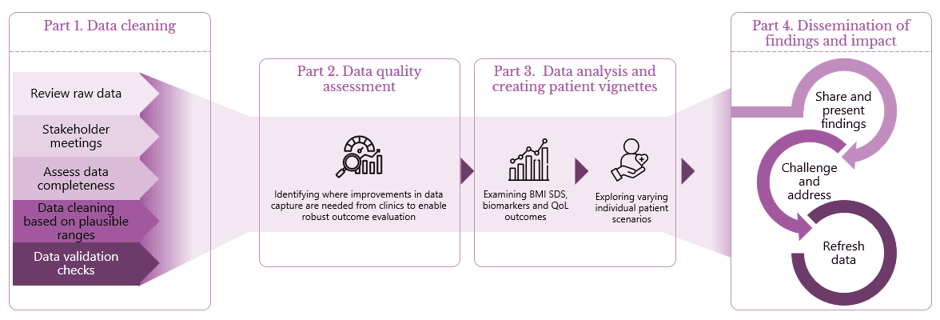
Figure 1. Our analytical framework
For analysis, we began by focusing on changes in BMI SDS (Body Mass Index Standard Deviation Score), an age- and sex-adjusted measure commonly used to assess clinical effectiveness in paediatric weight management. However, as the CEW service model aims to improve broader physical and psychological health outcomes, we extended our analysis beyond BMI SDS alone to assess holistic impact – examining obesity-related comorbidities and respective biomarker data, and quality of life (QoL) measures. Interpreting these outcomes required not only analysing clinical data, but also identifying data quality limitations that may affect interpretation.
“Working with Edge Health has been a genuinely collaborative experience. Their team combined strong analytical expertise with an open and supportive approach, helping to translate complex clinical data into meaningful insights. We hope the findings will support NHS England in making informed decisions about the future of the CEW programme.”
Maria Walschikow
Eclipse Integration Lead
Strengthening the evidence base
Our work highlighted data quality as a key enabler for evidencing the effectiveness of CEW clinics. By identifying gaps in completeness and variation across clinics, we demonstrated how data quality directly affects the reliability of insights. By sharing these findings directly with clinic teams across the programme, we helped surface the implications of variation in data completeness – encouraging recognition of the value of consistent, high-quality data collection. This enabled NHSE to reinforce expectations and drive improvements in data entry and collection processes. Following the engagement with clinics, baseline biomarker completeness improved substantially within four months, increasing from 23-52% to 60-83%.
Impact
By turning data into action, this work has strengthened the evidence base for CEW clinics and supported informed national decision-making on their future direction.

Christian Moroy
Christian is a Director and Co-Founder of Edge Health. He leads teams of consultants and analytical experts in the delivery of client engagements delivering advice, products and support that enable evidence-based decisions, strategic support and operational improvement.

Maria Starovoitova
Maria is a Senior Consultant at Edge Health with a background in statistics and computer science.
She has a diverse set of experiences supporting NHS organisations with statistical analysis, demand and forecasting modelling, data visualisation and application development.

Emily Zhai
Emily is a Senior Analyst at Edge Health with a multidisciplinary background in neuroscience, anthropology and women’s and gender studies.